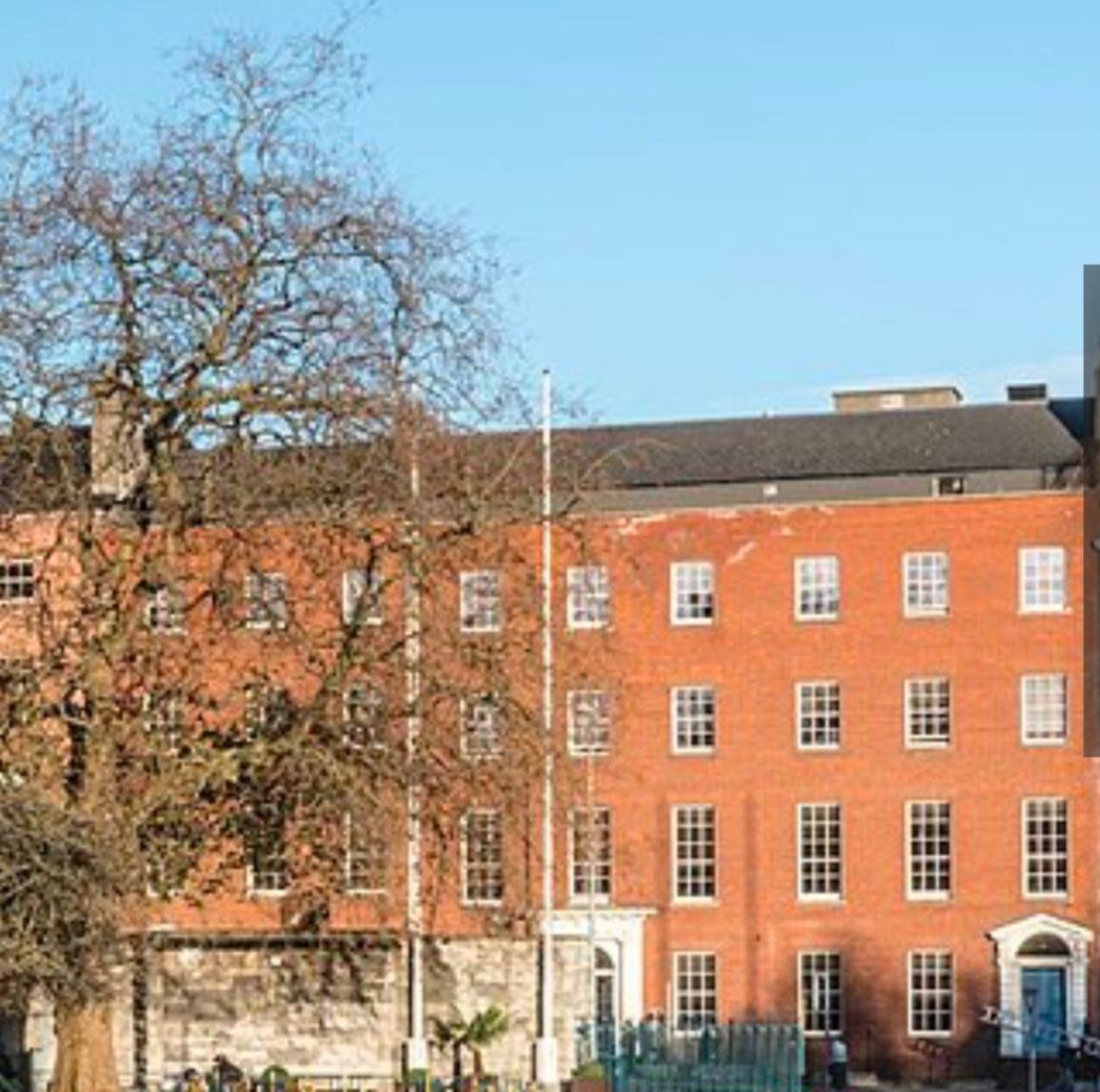
1958-'63 I was in high school from 1958 to 1963. The school was Coláiste Muire in Parnell Square in the north inner city of Dublin. Again it was an all-Irish school, meaning all teaching and conversation was in Irish. So, Latin had a Latin–Irish dictionary and French was similar. And while it was a relief to escape the sadists in primary school, in high school the sadists were traded for some pedophiles. My class (we were 30 kids) got the latter, but as he didn’t prey on me I was happy to have the corporal punishment behind me (pun not intended). The school was run by the Christian Brothers, as were most secondary schools in Ireland. In fact the Catholic Church ran essentially all education in the country. There were a handful of Protestant schools and even one or two non-religious schools.
Among the Catholic schools, there was a degree of snobbery. For boys (all these schools were single-sex) the schools run by priests were for the wealthier pupils while the Christian Brothers was for the rest of us. The same was true even in the girls’ schools run by the nuns.
Back to Coláiste Muire. The school was heavily academically oriented. There was a lot of homework and the syllabus was broad. I think I had ten subjects for the Inter Cert, taken at age 15 and perhaps a couple less for the Leaving Cert taken at 17-18 which also served as the Entrance to University.
The school played Gaelic games, i.e. hurling and Gaelic football.
These games were widely played around the country under the aegis of an organization called the GAA. Founded in the 19th century, this organization grew at the same time as the Gaelic League (an Irish language society) and was part of the 19th century Nationalist resurgence seeking a free Irish Ireland, which ultimately gained expression in the Easter Rising of 1916.
Some of these nationalist threads undoubtedly led to my being sent to Irish-speaking schools.
Amazingly, however, four of us students were excused from playing football on Wednesday afternoons that were devoted to sport. We were permitted to play tennis at a location (unsupervised!) of our own choosing. This was remarkable when one understands that the GAA banned its members from playing “foreign games.” These were games associated with the formerly occupying British army and the “West Brit” Irish who mimicked them. So Ireland never produced soccer or cricket teams, and rugby has only recently become popular. Whether tennis was considered a “foreign” game I never learned.
One of the school’s initiatives during my time was the construction of a theatre. Following on from this, an annual Irish language allegorical drama featuring figures from Irish mythology was staged. The effort took up quite a bit of school time which provided non-actors like me with increased spare time. The drama was directed by a larger than life Irish speaker who was the artistic director of the famed Abbey Theater.
Overall, I had no complaints about high school. The kids were fine, although none came from the city’s south side where we lived, so I hardly saw them apart from school life. I actually enjoyed the intellectual stretch, and while I was not wholly devoted to academics, in the end, I was third or fourth in the class. The school was actually fee-paying. I believe it cost £15 sterling a year. This sounds trivial, but it was actually a major ask for my parents. Ireland in the 1950s was a very poor, rural country. And while we didn’t really want for anything, there wasn’t anything to spare. There were frequent visits to Collon to bring back veggies. At Christmas, other friends from the country would appear with turkeys. Also the two aunts from Collon would give us 10 shillings each, but that was corralled by mother who gave us books probably costing 2/6 shillings!
When I was born, the new Irish state was only 24 years old. In that time it had built the infrastructure to provide electricity to much of the country which had been lacking under British rule.
At independence, Dublin had some of the worst slums in Europe.
By the 1950s these had all been demolished and vast new tracts of well-constructed social housing had been built around south Dublin. Nonetheless, when we went down to Collon and Limerick there were no toilets, so outdoors was the go! And as I said earlier, I don’t think we got a TV until around 1960 when the first Irish broadcaster went on air, and in or around the same time we finally got a phone. A social welfare payment called “Children’s Allowances,” paid monthly, helped struggling families and the dole helped the unemployed, of whom there were many. Frank McCourt described the environment memorably. Things would have been even worse in the country if it were not for the safety valve of emigration, especially to England. My mother always said she was raising her children for “the emigrant ship”!
You can tell that Mammy had a wry, if not ironic sense of humour. She also had a range of interesting friends and acquaintances. Among them were ageing ex-revolutionaries (Peadar O’Donnell), the headmaster of Dermot’s non-denominational coed secondary school, and an Irishman who had headed the Communist Party in New York and been permanently expelled from the US. And the Harkins, who were intellectuals who had two lovely boys, one of whom was quite a promising artist. We used to visit them every Christmas and bring them a Christmas cake Mammy had made.
But times were changing. Despite misplaced efforts to keep Ireland rural, Gaelic and insular with a heavy reliance on censorship, foreign influences, mostly American, were seeping in, nowhere more so than in pop music. The first tune I really loved was Paul Anka’s 1958 recording of “Diana.” We had no record player, but Mary Cassidy did. To let me hear Diana repeatedly she brought me up to her house. I met her mother, father, and sister, and played and played Diana to my heart’s content. Next on the music scene, in 1959, came Phil Spector’s Wall of Sound. At the same time Elvis Presley was dominating Rock ‘n Roll. I remember queuing up for ages to get into the cinema to see G.I. Blues when it came out in 1960. I remember that Bill Haley and the Comets played in Dublin. My parents went and my father came home disgusted by the hip-shaking moves on stage!
Sometime during the high school years I started going to tennis club “hops.” Initially this was in Glenanne, my home tennis club, but later that expanded to other venues. The dances were thrilling, jam packed sweaty bodies moving slowly around to the latest records. I have no idea how I got to the various venues, or who I might have gone with. Walked, maybe. Towards the end of the period, I got friendly with Tony Brophy, a working-class kid who left school at 12 and was gifted mechanically. He had motorbikes before any of the rest of us and was generous about giving lifts. I do know that one time when I was curfewed at home I climbed out of the back window of the house and went off with Tony to a dance on the city’s north side. I think maybe in 1963, having secured the University scholarship, I bought a brand new Honda 50 motorbike. This was the start of a period dominated by extensive efforts to go faster!
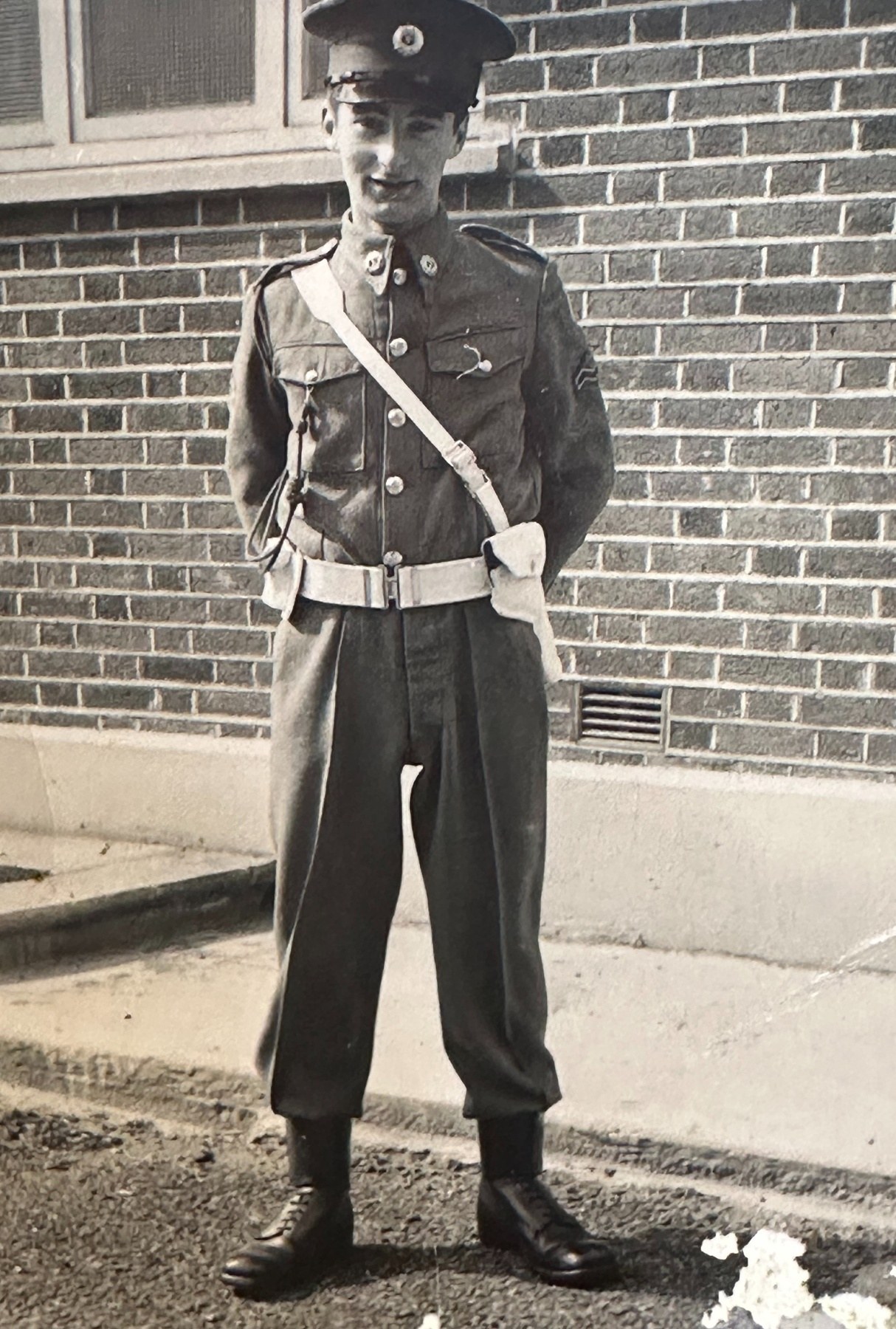
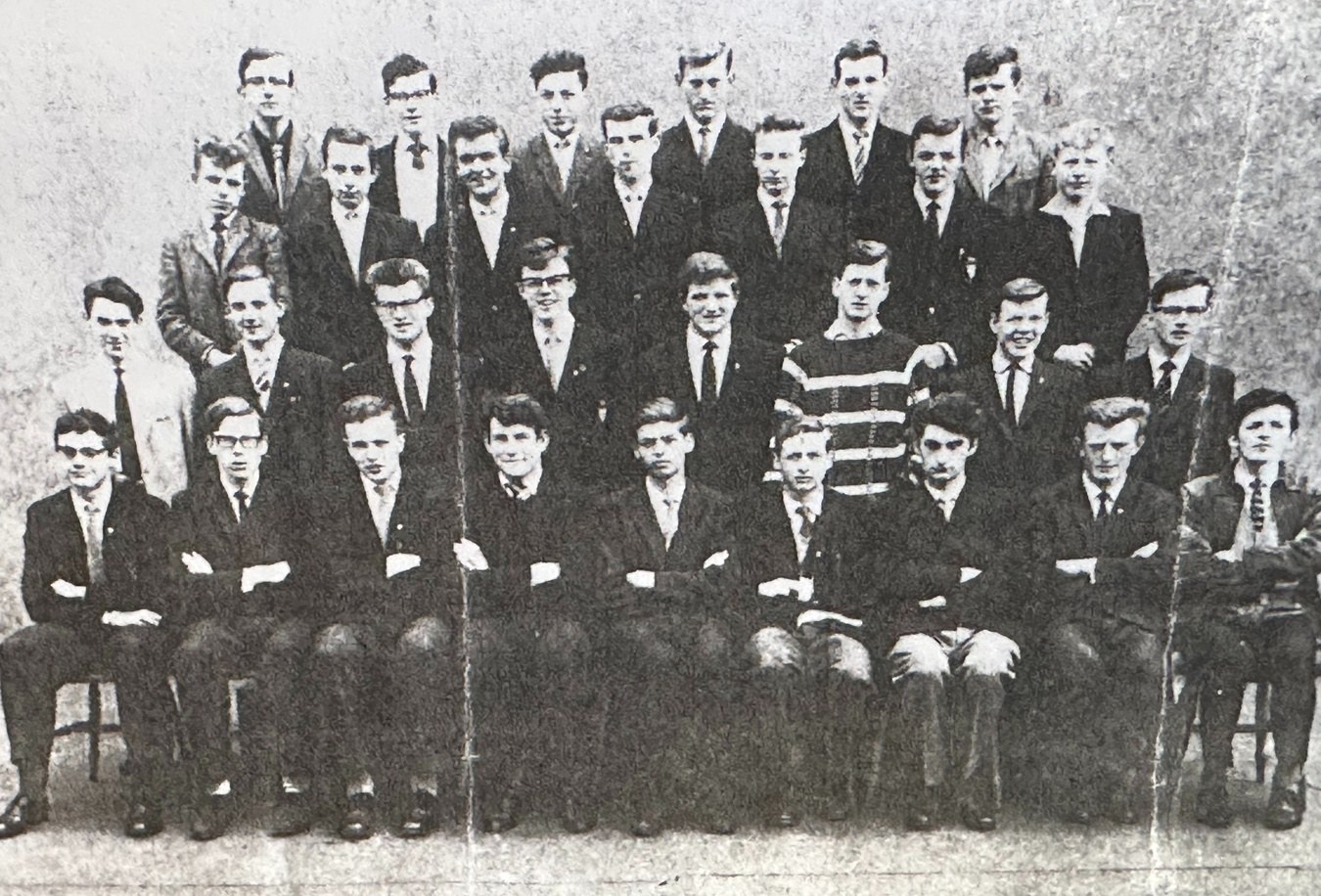
From the middle years of high school I had a steady girlfriend, which I think lasted for four or five years. I was spending a lot of whatever free time I had mostly with Tony, though sometimes with Oliver. Sometimes, Kevin Brady, a pal from my high school class, would come up to the house to play poker with us. He still, fifty years later, talks about the sandwiches Mammy would make for the card players. Kevin used to say that the worst part of losing at poker was having to share his non-existent ‘winnings’ with his wife! There were also the three guys I played tennis with (including Colum Murphy whom I saw recently in Geneva) and in class I had four pals who had moved with me from primary school. One of those guys, Cathal O’Luain (front row, extreme right on page 23) persuaded me to join the FCA, a sort of military home guard or Local Defense Force. Hence, the photo below.
So, an era that started with soppy Doo Wop, ended with the precedent-shattering music of The Beatles, and then the counter-culture eruption of the Rolling Stones. We just about managed to maintain a semblance of normality to get out of High School while all of this ferment was going on around us.
The “Times They Were A-Changin’.” We were now headed into the revolutionary 60s!
Continue Reading
—
What Was Your Dad Like?
What was my Dad like when I was a child, a question posed by StoryWorth? I suppose the overriding sense would be that he was a father figure, but not a father. I have no memory of him ever reaching out to me or touching me, or really even talking to me.…