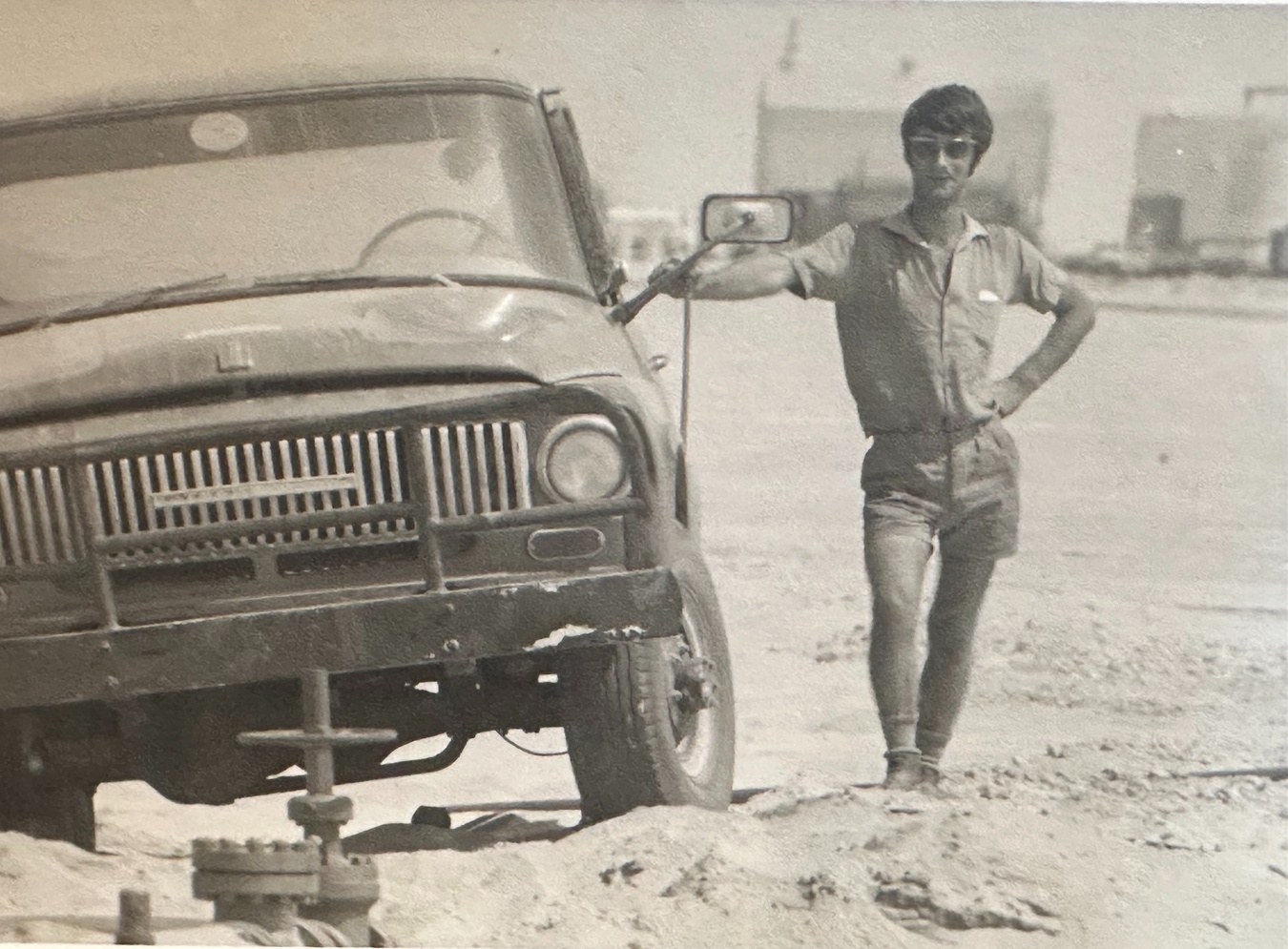
I flew to Tripoli, Libya in Autumn ’68, and never would a person go through a greater, more life-altering step-changing experience!
Tripoli was a sight. Still run by Italians (restaurants, barbers, cobblers, you name it). It was also warm and sunny under intense blue Mediterranean skies in November, which led me to want to always live in sunny climes thereafter. The Mobil Oil folks in the office (mostly American) were really welcoming and friendly. Also friendly in a very different way were some very large local gents who sought to engage me (romantically?) at the bar in the town’s best hotel (The Libya Palace Hotel). A new experience.
After a couple of days in the office, it was out to the desert on the company plane, a DC-3! After a very brief orientation and trying to understand what the training regimen would encompass, I was dispatched to a drilling rig. Without boring you, the Petroleum disciplines are mainly Drilling, Production, Reservoir, so in theory we should have been given an orientation involving all three. ‘Reservoir Engineering’ allegedly required more experience, so got left to last. For us in the field it was an attractive training destination because it was office-based in Tripoli. Town, of course, was where it was all happening!
Two things about Petroleum Engineering. I asked how come they recruited engineers from other disciplines, like Mechanical, (remember, this was before the advent of North Sea oil and I had never heard of oilfield exploitation). Mobil’s answer was, “If you can get an engineering degree, we can make you into a Petroleum Engineer!” Another interesting thing was that they never recruited again from the UK or Ireland! The intake the next year were from the US! So, how lucky was I! Entry into a lifelong, fascinating, and rewarding career happened by a fluke.
The first few rotations (45/18) on the drilling rig were mainly notable for the vast quantities of food that were served up daily.
When I went to Libya I weighed 140 lbs. After 3 months I weighed 160 lbs! The other interesting thing about the rig—apart from the fact that I had never worked in close quarters with Americans (or anybody else, for that matter) was that the crew was Mormon! So, no alcohol, no sodas, no coffee etc. Very dull, but again very nice helpful people. Not all rigs were necessarily like that. On one flight home a rig hand going on R&R bit the bottom of an air hostess who had leaned over to serve somebody. The rest of the tough passengers threatened to kill this guy— not for what he had done, but for fear that the plane would return to Tripoli, which no one wanted. As it was the plane diverted to Malta, so I spent a couple of days wandering around Valletta.
After a few months of learning the ropes, I graduated to the main field office and started doing lots of other oily things. Again, there was usually a mentor-type, senior engineer who came out from Tripoli and would help you progress. To this day I am still in awe of the time and interest the senior people took in us Junior Engineers, as we were called. Very quickly I was doing all sorts of things on my own, from testing new oil wells (lighting the flare incorrectly one time burned all the hair off my face, including eyebrows), to supervising the construction of oil processing stations (I built one the ‘wrong’ way around). There was a great deal of hustle in 1969. Maybe the higher-ups sensed what was coming. We worked all hours and often through the night. I can vividly remember sitting in a Land Rover at 4 am monitoring a drilling rig, with the big boss coming by to check up! But it was fun too, haring around the desert at high speed.
Sometimes even seeing the debris left over from burned out British Army hardware, courtesy of German General Rommel. fr The only really scary thing I experienced was when I was guiding a truckload of equipment deep in the south of the Sahara and got lost for 3 days in a sandstorm. We then ran out of fuel (going around in circles, maybe?). I did think I might perish, but then on day 4 a Mobil search plane sent to find me spotted us, and we were rescued. Fun times.
The schedule we worked was 45/18: Libya and home. Travel from Dublin to Tripoli transited through Rome airport, and to my mind, that’s where “civilization” ended. Once you went to board a plane in Rome in the direction of Tripoli, it was chaos. No rules, no orderly lines—just pushing and shoving. The scheduled travel was helpful for taking one or two days in Rome or other nearby destinations. But I was usually in a hurry to get back to spend my days off with Liz, so I hardly used that opportunity.
I mentioned before that there was an Irish grad student in UCD who was also working for Mobil Oil in Libya, Bernard Gillespie.
He was a bit of a dry stick, but sometimes our schedules coincided, and we traveled together between Dublin and Tripoli.
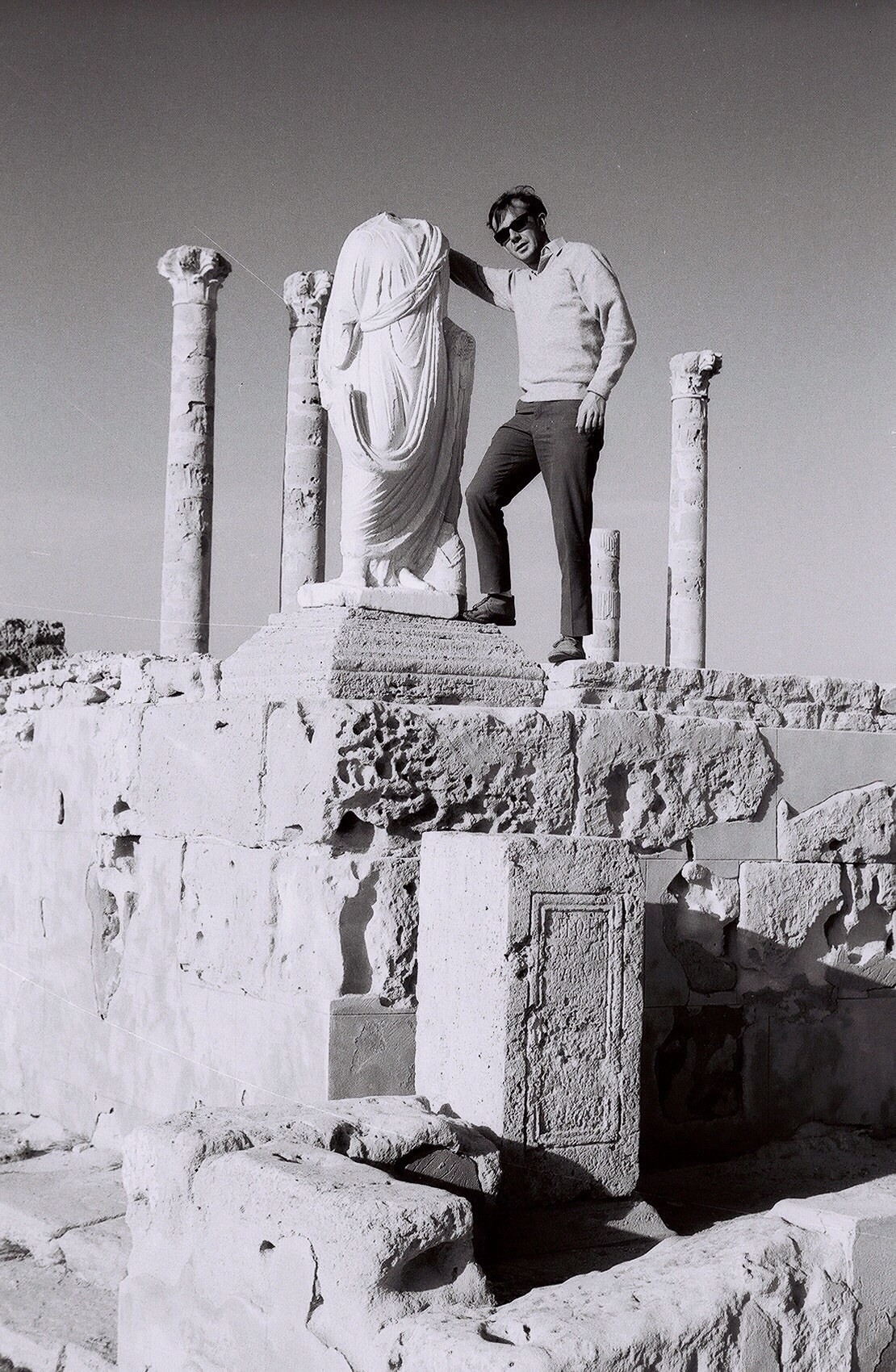
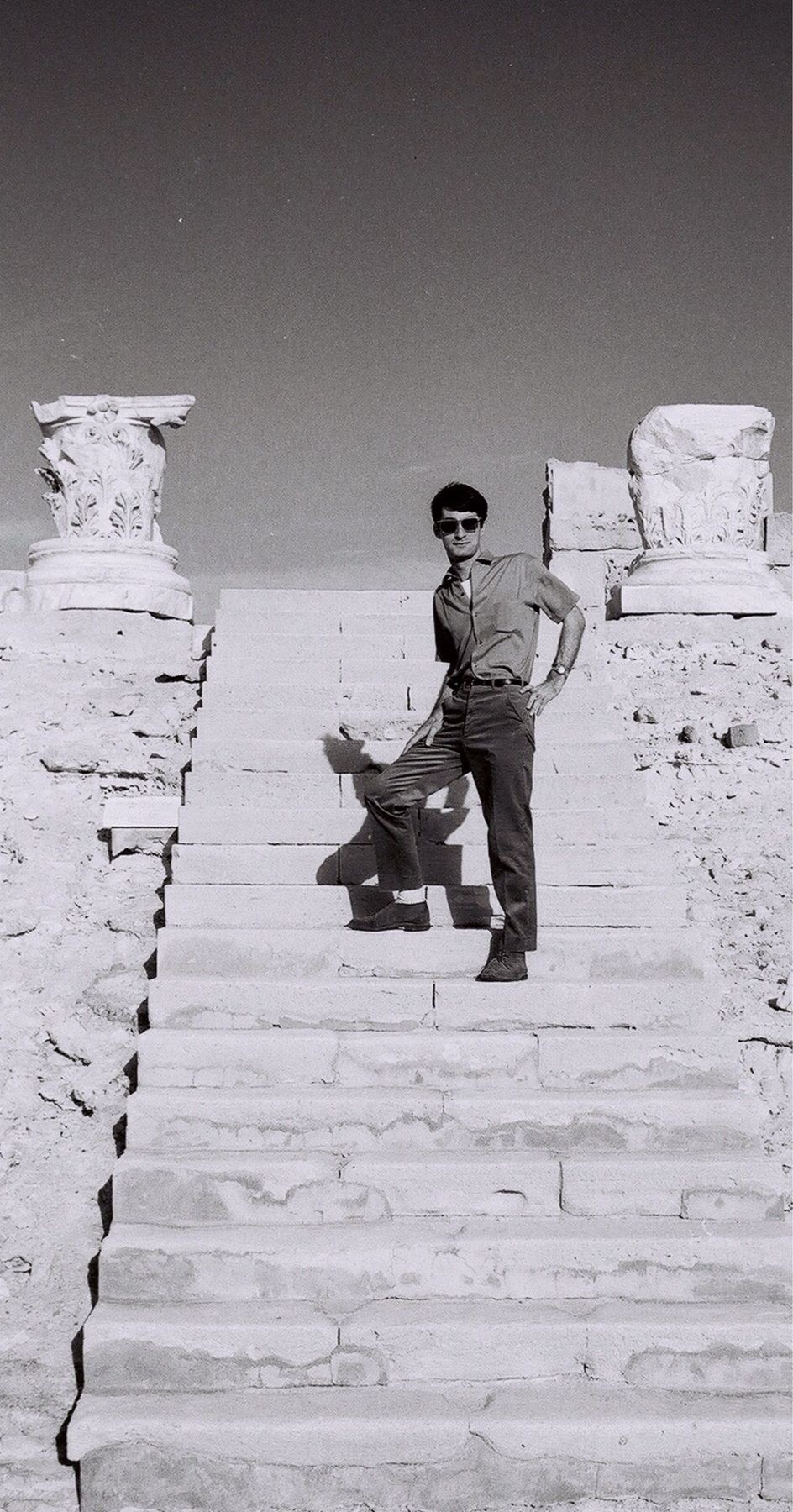
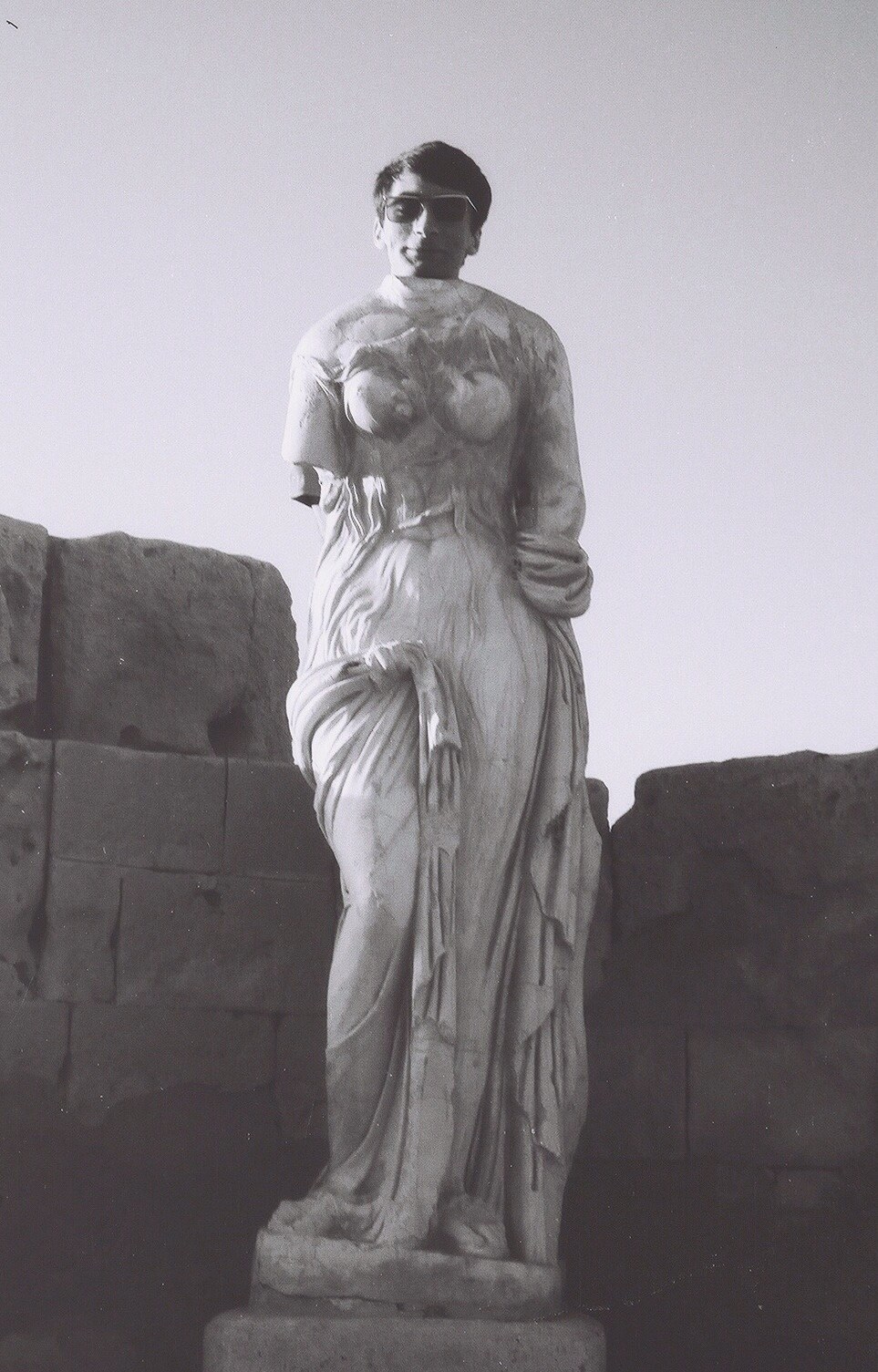
He managed to spend a lot more time in the Tripoli office than I did, but we did do stuff together, like swimming in the deserted Libyan Med, or exploring the equally deserted, magnificent Roman remains of Leptis Magna and Sabratha, Tripoli itself being the third Tripolis of the Roman province. There is no doubt that these Roman ruins are far and away the best in the world, and largely unvisited. When the photos which follow were taken, there was nobody else there!
The year from September ‘68 to September ‘69 was jam-packed with experiences which brought great personal growth and memories that are vivid to this day. In Libya we were so busy, and Mobil pushed us to grow in experience as quickly as we could, that it felt like a whirlwind. I had never experienced executives so caring and so obviously eager to be helpful. I had never been pushed to learn so quickly or to take on what, to me, seemed immense and potentially costly responsibility. Rotating through Tripoli was fun and light-filled. The city side roads were sand tracks but the town had everything. It was how I imagine a new recruit in the French Foreign Legion must have felt.
And at home of course Liz and I did things together, went places, saw friends. What an awesome, memorable year!
There is no doubt that my first 12 months of real employment were fantastical. I was learning at a phenomenal rate, when in the field I worked all sorts of crazy hours, I was close to being unsupervised and I liked the people I worked with. An interesting snippet. I was supervising the new American engineers in July 1969 and found they were getting paid about 3 times my salary . I complained to the Engineering manager in Tripoli, Bob Mills (of whom more later). He said he was sympathetic, but that if I got paid what the Americans earned I’d be earning more that the PM of the UK! He did however bump up my salary.
As I said, we were being worked off our feet, tying in new oil wells as fast as we could and exporting the oil. The desert was crawling with phenomenally highly paid American welders who were constructing new pipelines at breakneck speed. I sometimes used to wish for the pressure to ease off….but as they say, be careful what you wish for!
Continue Reading
1969
All Change
On the 1st of September, 1969, my work mates and I were leaving the airstrip in the middle of the desert on the Mobil DC-3. We were about 5 feet off the ground and slowly rising when a Jeep with mounted machine gun and Libyan troops came barreling down the runway towards us at speed. Fortunately we were able to clim…