Why is 1974 picked out as a key date for me in this story? It was picked because it’s one of two years when events in the oil industry had a global impact. And of course, in addition to impacting worldwide economies, it greatly influenced the career path of people working in the industry.
Before 1974, ADPC owned its oil concession 100% and paid royalties to the ruler, Shaikh Zayed. This situation had come about after World War I when a crafty man named Gulbenkian, mentioned above as Mr. 5%, had negotiated licenses for oil exploitation in Iraq and the Arabian Gulf Protectorates. He retained a 5% interest (and was thereafter called Mr. 5%) in all the revenue when these countries became oil producers, and the Majors divided the other 95% among themselves. The UAE, the agglomeration of the tiny statelets along the Persian Gulf coast (Abu Dhabi, Dubai, Sharjah, etc.), was only established in January 1972 with independence from Britain and so was really struggling to establish itself and hire people for the normal roles of government. As the posted price of oil was controlled by the oil Majors (Shell, BP, Exxon, Mobil, etc), and they posted $3 per barrel, the host countries weren’t doing too well either. Aside from keeping the oil price low, the other benefit for ADPC was that there was no Abu Dhabi government oversight of operations. It seems to me that this translated into a laissez-faire approach to running the business, so we mostly took it easy and had plenty of time for water sports, tennis, Bridge, dinner parties and drinking!
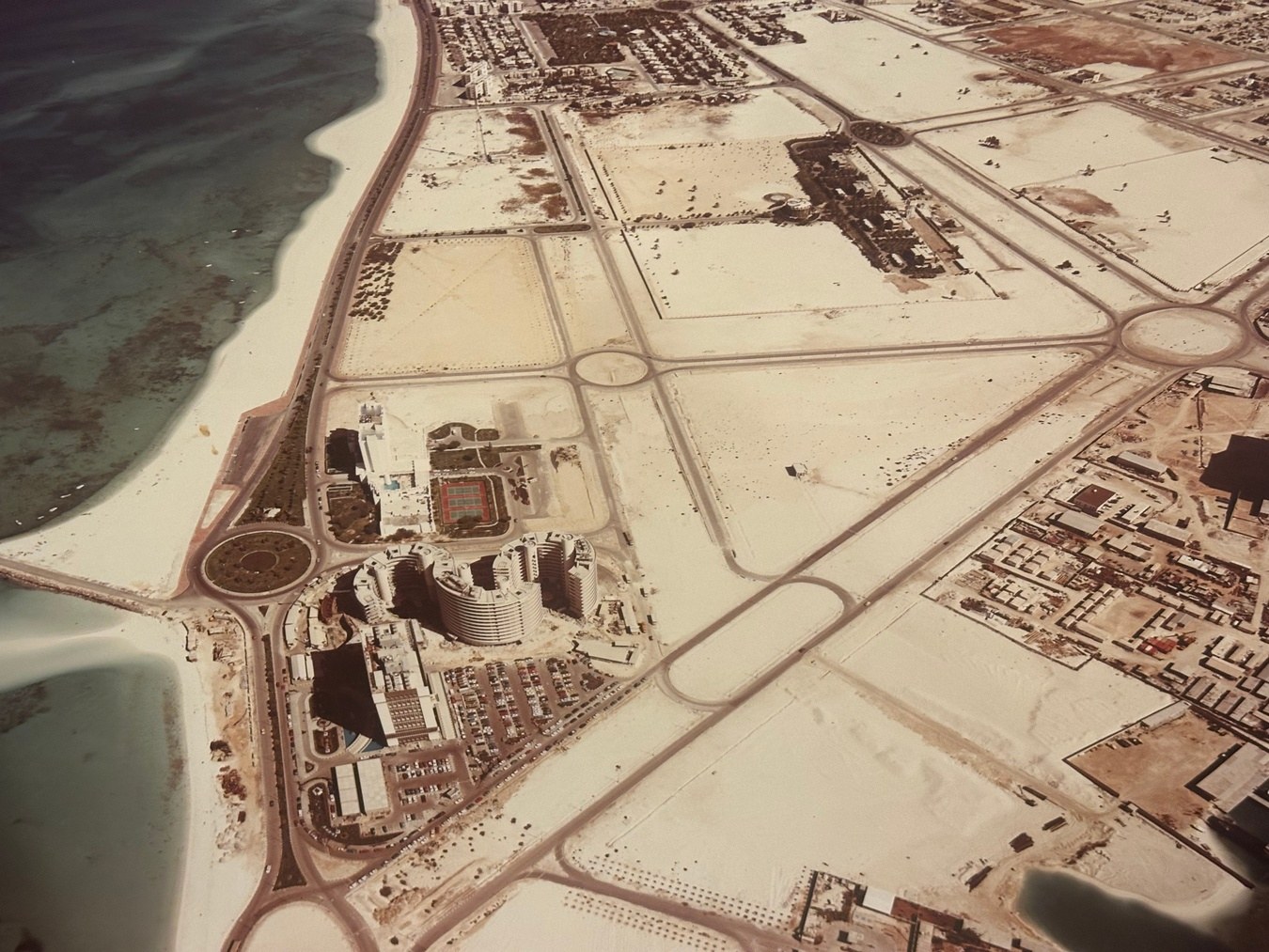
The pre-‘74 period was also marked by the scarcity of both expats and Arabs in the country. Expats probably numbered fewer than 100 and local Arabs were only really noticeable during festivals (Eids,) when the Bedouin came in from the desert in all their regalia and performed traditional dances involving waving very large swords while swathed in copious ammo belts. As the country slowly became more organized, palace construction for the sheikhs took off and more roads were built. In fact, around this time, there was still no road connecting Abu Dhabi with Dubai. A nice initiative was the organization of camel races.
There was a sort of makeshift oval, the jockeys seemed about 12 years old and the sheikhs attended in the midst of the spectators.
In fact on a number of occasions we were able to shake hands with the ruler, Sheikh Zayed, and congratulate him on the country’s progress. There still were not many people in the country.
But everything changed in 1974. The proximate cause was the Yom Kippur war in October 1973, which led to an Arab oil embargo. This in turn led to gasoline shortages in a number of countries, not least the US where Colm and Catriona and Liz and I were driving across the U.S. to the West Coast and back to Chicago, where Dermot was. I had been in Houston attending a very demanding reservoir engineering school at Exxon’s facilities. This was mind-bendingly challenging and I sheepishly saw that there were people with intellects far superior to mine.
However, it was part of the “career development” that was such a feature of the oil industry’s care for the progress of their employees.
The saddest part of the energy shortage was the Las Vegas Strip where, when we got there, the illuminations had been turned off to save power!
During the scramble that ensued during the oil embargo, Gaddafi recognized that he could charge more for Libya’s oil. So he did, and it worked. When the Shah of Iran saw that, he doubled the price again, and that stuck! Oil that, six months earlier, had been selling for $3 per barrel was now commanding $12 per barrel.
This windfall gave rise to all sorts of excesses as the small economies of the Persian Gulf tried to absorb the “manna from heaven.” I can recall seeing Bedouin with vast rolls of $100 bills pulled out from their dishdashas buying all the biggest, most expensive audio electronics. There wasn’t much else really, but that was quickly remedied by Ferrari and Rolex importers and of course, shopping trips to Harrods in London.
And speaking of London, I was there during the strife associated with the UK coal miners’ ’73/’74 strike. I was working with consultants on a complicated 3D computer-numerical simulation of an Abu Dhabi oil reservoir. Because of a lack of coal, the government instituted a three-day workweek to conserve energy. No lights in London, garbage piled high in the streets. The Provisional IRA added to the mess by conducting a bombing campaign on the UK mainland.
For the oil industry there were other major changes afoot. The producing countries moved at varying speeds to take over partial ownership (Abu Dhabi) or full ownership (Saudi Arabia) of the oil industry. In Abu Dhabi the request was for 60% and this was ultimately granted. This ownership was placed in a new national oil company called ADNOC. As the major shareholder they were now setting out to control the activities of ADPC. They were being advised by Algerians who had a great antipathy to the Western Majors, and who were very savvy.The first initiative of this new regime was to force the abandonment of the ADPC structure. Until now, company personnel were primarily English employees of the Iraq Petroleum Company. Now they would need to be employed directly by the shareholders. So Shell, BP etc. came out and interviewed everybody to decide who they would offer jobs to. Most people, being Brits, got either one or two offers from Shell and/or BP. I was the only person to get offers from all five shareholders! Of course, I rejoined Mobil. A sort of funny thing did happen though. BP was so keen to hire me that they came and said “we know you would like to be in the US, so we will locate you in San Francisco if you will join us”. No known oil in San Francisco, so it was sort of a tempting offer, though a little strange. Another career road not taken.
By this stage, my career was progressing nicely. I was a Senior Reservoir Engineer and as such had to defend the plans we had for exploiting the Abu Dhabi oil fields at shareholder technical committee meetings. This had been purely technical when conducted by the visiting experts from the major shareholders until now. But it became something more under the pressure of ADNOC. We called it “political reservoir management” because the actions seemed to be designed for more than technical reasons, such as requiring the use of more drilling rigs which just happened to be owned by their Iraqi friends. Anyway, the good old laissez-faire days were over and there was now a tension underlying the oil field operations. And of course, with the newly wealthy environment, all sorts of people poured into Abu Dhabi. The good old days were gone.




Continue Reading
1977–1980
Progress
Sometime in 1977, my career took another step forward when I was promoted to the role of Chief Petroleum Engineer. That probably happened more because so many experienced people had already been transferred out, than because I was a good candidate. Whatever the reason, being in the right place at the right time seem…